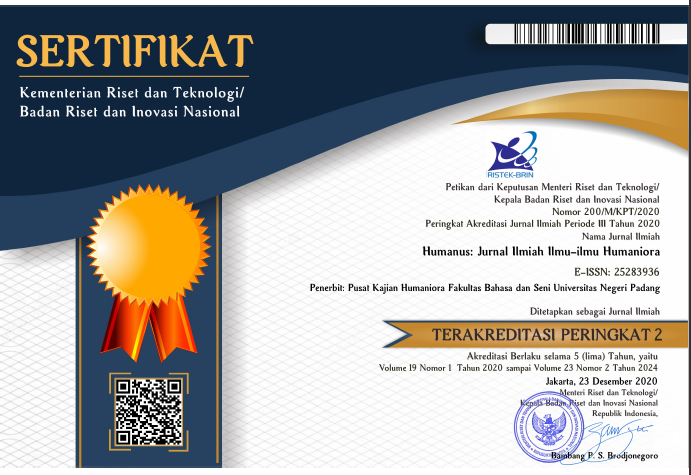
An Anthropolinguistic Analysis of Language Use in Anti-Female Genital Mutilation Campaign on @puan_amalhayati Instagram Account
 ), Sajarwa Sajarwa(2), Aprillia Firmonasari(3),
 (1) Program Studi Doktor Ilmu-Ilmu Humaniora, Fakultas Ilmu Budaya, Universitas Gadjah Mada.
 Indonesia
(2) Program Studi Doktor Ilmu-Ilmu Humaniora, Fakultas Ilmu Budaya, Universitas Gadjah Mada.
Indonesia
(3) Program Studi Doktor Ilmu-Ilmu Humaniora, Fakultas Ilmu Budaya, Universitas Gadjah Mada.
Indonesia
Corresponding Author
Copyright (c) 2025 Qurrota A'yunin, Sajarwa Sajarwa, Aprillia Firmonasari
DOI : https://doi.org/10.24036/humanus.v24i2.134872
Full Text:
 Language : en
Abstract
Keywords
References
Abdelshahid, A., & Campbell, C. (2014). ‘Should I Circumcise My Daughter?’ Exploring Diversity and Ambivalence in Egyptian Parents’ Social Representations of Female Circumcision. Journal of Community & Applied Social Psycology, 25(1), 49–65.
Abidogun, T. M., Alyssa Ramnarine, L., Fouladi, N., Owens, J., Abusalih, H. H., Bernstein, J., & Aboul-Enein, B. H. (2022). Female genital mutilation and cutting in the Arab League and diaspora: A systematic review of preventive interventions. In Tropical Medicine and International Health (Vol. 27, Issue 5, pp. 468–478). John Wiley and Sons Inc. https://doi.org/10.1111/tmi.13749
Agustina, A. M., & Ismah, N. (2024). Challenging Traditional Islamic Authority: Indonesian Female Ulama and the Fatwa Against Forced Marriages. Journal of Islamic Law, 5(1), 125–146. http://e-journal.iainptk.ac.id/index.php/jil/article/view/2319
Ainslie, M. J. (2015). The 2009 Malaysian Female Circumcision Fatwa: State ownership of Islam and the current impasse. Women’s Studies International Forum, 52(September 2015), 1–9. https://doi.org/10.1016/j.wsif.2015.06.015
Anshor, M. U., & Hewatt, S. (2017). Pemotongan Dan Perlukaan Genitalia Perempuan (P2Gp): Dalam Persimpangan Antara Tradisi Dan Modernitas. In Komisi Nasional Perempuan dan Pusat Studi Kependudukan dan Kebijakan Universitas Gajah Mada.
Ansori. (2022). Position of fatwa in Islamic law: the effectiveness of MUI, NU, and Muhammadiyah fatwas. Ijtihad: Jurnal Wacana Hukum Islam Dan Kemanusiaan, 22(1), 53–71. https://doi.org/10.18326/ijtihad.v22i1.53-71
Babbs, G., Weber, S. E., Abdalla, S. M., Cesare, N., & Nsoesie, E. O. (2023). Use of machine learning methods to understand discussions of female genital mutilation/cutting on social media. PLOS Global Public Health, 3(7). https://doi.org/10.1371/journal.pgph.0000878
Bourdieu, Pierre. (1991). Language and Symbolic Power (J. B. Thompson, Ed.). Polity Press.
Bouvier, G., & Machin, D. (2018). Critical discourse analysis and the challenges and opportunities of social media. Review of Communication, 18(3), 178–192. https://doi.org/10.1080/15358593.2018.1479881
Danesi, M. (2004). A Basic Course in Anthropological Linguistics (Studies in Linguistic and Cultural Anthropology) (Vol. 1). Canadian Scholars’ Press Inc.
DeLaet, D. L. (2024). FGM and genital cutting across borders: cultural biases in the contestation of global human rights. Identities, 00(00), 1–20. https://doi.org/10.1080/1070289X.2024.2373607
Diaz, M. P., Brown, A. E., Fleet, J. A., & Steen, M. (2023). What women want: A reflexive thematic analysis of the healthcare experiences of women with female genital mutilation/cutting in South Australia. Women and Birth, 36(6), e652–e660. https://doi.org/10.1016/j.wombi.2023.06.004
Dwifatma, A., & Beta, A. R. (2024). The “Funny Line Veil” and the mediated political subjectivity of Muslim women in Indonesia. Asian Journal of Communication, 34(3), 284–297. https://doi.org/10.1080/01292986.2024.2320900
Ekong, J. T. (2022). On the Political Epistimology of female Circumcision in Africa. European Journal of Philosophy, 6(2), 16–41. https://doi.org/10.47672/ejpcr.1172
Elamin, W., & Mason-Jones, A. J. (2019). Female Genital Mutilation/Cutting: A Systematic Review and Meta-ethnography Exploring Women’s Views of Why It Exists And Persists. International Journal of Sexual Health, 1–21. https://doi.org/https://doi.org/10.1080/19317611.2019.1683115
Elmorally, R. (2024). Decolonizing Female Genital Mutilation: A Harmful Yet Identity-Affirming Practice. IntechOpen. https://doi.org/https://doi.org/10.5772/intechopen.109837
Esho, T., Wolputte, S. Van, & Enzlin, P. (2011). The socio-cultural-symbolic nexus in the perpetuation of female genital cutting: a critical review of existing discourses. Afrika Focus, 24(2), 2011–2053. https://doi.org/https://doi.org/10.21825/af.v24i2.4997
Foley, W. (1997). Anthropological Linguistics: An Introduction. Blackwell Publisher Ltd.
Fusaschi, M. (2023). Gendered genital modifications in critical anthropology: from discourses on FGM/C to new technologies in the sex/gender system. In International Journal of Impotence Research (Vol. 35, Issue 1, pp. 6–15). Springer Nature. https://doi.org/10.1038/s41443-022-00542-y
Gele, A. A., Sagbakken, M., & Kumar, B. (2015). Is female circumcision evolving or dissolving in Norway? A qualitative study on attitudes toward the practice among young Somalis in the Oslo area. International Journal of Women’s Health, 7, 933–943. https://doi.org/10.2147/IJWH.S93217
Gruenbaum, E., Earp, B. D., & Shweder, R. A. (2023). Reconsidering the role of patriarchy in upholding female genital modifications: analysis of contemporary and pre-industrial societies. International Journal of Impotence Research, 35(3), 202–211. https://doi.org/10.1038/s41443-022-00581-5
Gustina, N. A., & Nareswari, L. A. (2023). Intersectionality Analysis of the Impact of AntiFemale Genital Mutilation/Cutting Policies in Indonesia and Egypt. Jurnal Politik, 9(2). https://doi.org/10.7454/jp.v9i2.1136
Habermas, J. (1991). The structural transformation of the public sphere: an inquiry into a category of bourgeois society. The MIT Press.
Ida, R., & Saud, M. (2020). Female Circumcision and the Construction of Female Sexuality: A Study on Madurese in Indonesia. Sexuality and Culture, 24(6), 1987–2006. https://doi.org/10.1007/s12119-020-09732-6
Ifendi, M. (2021a). Metode Pembelajaran Kitab Kuning Di Pondok Pesantren Sunan Drajad Banjarwati Lamongan. Al-Tarbawi Al-Haditsah: Jurnal Pendidikan Islam, 6(2), 85. https://doi.org/10.24235/tarbawi.v6i2.8898
Ifendi, M. (2021b). Metode Pembelajaran Kitab Kuning Di Pondok Pesantren Sunan Drajad Banjarwati Lamongan. Al-Tarbawi Al-Haditsah: Jurnal Pendidikan Islam, 6(2), 85. https://doi.org/10.24235/tarbawi.v6i2.8898
Julios, C. (2019). Female Genital Mutilation and Social Media. Routledge. https://libgen.li/ads.php?md5=644f5e924e33a66d66b9ac8c5a86d4e2
Kelleher, R. (2019). The Cut in Conflict: Female Genital Mutilation and the Concept of Religious Violence in the Western World. Journal of the Council for Research on Religion, 1, 45–69. https://doi.org/10.26443/jcreor.v1i0.5
Lakoff, G. (2004). Don’t Think of an Elephant! Know Your Values and Framethe Debate. Chelsea Green Publishing.
Listiorini, D. (2014). Pertarungan Wacana Sunat Perempuan di Internet. BERNAS Jogja.
Maynard, D., Roberts, I., Greenwood, M. A., Rout, D., & Bontcheva, K. (2017). This is a repository copy of A Framework for Real-time Semantic Social Media Analysis. Journal of Web Semantics, Manuscript.
Miller, D. (2021). The Anthropology of Social Media. In H. Geismar & H. Knox (Eds.), Digital Anthropology (2nd ed., pp. 85–101). Routledge.
Mundzir, I., & Muthmainnah, Y. (2022). The progressiveness of Quranic interpretation in the fatwa of Muhammadiyah on female circumcision. Indonesian Journal of Islam and …, 12(2), 285–311. https://doi.org/DOI:10.18326/ijims.v12i2.285-311
Mwendwa, P., Kroll, T., & Brun, A. De. (2020). An Exploratory Analysis of Social Media Discussions on Female Genital. Journal of African Interdisciplinary Studies (JAIS), 4(1), 34–47.
Ndasi, D. M., & Adusei-Asante, K. (2019). Female Genital Mutilation/Cutting: A Conceptual Discussion. Advances in Social Sciences Research Journal, 6(11), 232–246. https://doi.org/10.14738/assrj.611.7300
Papacharissi, Z. (2002). The virtual sphere: The internet as a public sphere. New Media and Society, 4(1), 9–27. https://doi.org/10.1177/14614440222226244
Perrino, S. M., & Pritzker, S. E. (Eds.). (2022). Research Methods in Linguistic Anthropology. Bloomsbury Academic.
Prazak, M., & Coffman, J. (2007). Anthropological Perspectives on Female Genital Cutting: Embodying Tradition, Violence, and Social Resilience. Africa Today, Indiana University Press, 53(4), v–xi.
Sekar Kasih, A. R., & Maharani, T. (2024). Transformasi Ruang Publik Digital: Studi Kasus Komentar Netizen dalam Akun Curhat. Kajian Linguistik Dan Sastra, 9(1), 24–42. https://doi.org/10.23917/kls.v9i1.5068
Shell-Duncan, B. (2022). Social and structural factors influencing women’s agency regarding female genital mutilation/ cutting: an intersectional analysis – a reply to ‘The prosecution of Dawoodi Bohra women’ by Richard Shweder. Global Discourse, 12(1), 167–187. https://doi.org/10.1332/204378921X16345524513807
Silverman, E. K. (2004). Anthropology and Circumcision. Annual Review of Anthropology, 33(1), 419–445.
Silverstein, M. (2003). Indexical order and the dialectics of sociolinguistic life. Language and Communication, 23(3–4), 193–229. https://doi.org/10.1016/S0271-5309(03)00013-2
Spitulnik, D. (1996). The Social Circulation of Media Discourse and the Mediation of Communities. In Source: Journal of Linguistic Anthropology (Vol. 6, Issue 2).
UNICEF. (2024). Global Databases of FGM Prevalence among Girls Aged 0-14.
Vissandjee, B., Denetto, S., Migliardi, P., & Proctor, J. (2014). Female Genital Cutting (FGC) and the ethics of Care: Community Engagement and Cultural Sensitivity at the Interface of migration Experiences. BMC Biophysics, 4(1), 2–10. https://doi.org/10.1186/2046-1682-4-13
Wondwossen Fantaye, A., & Konkle, A. T. M. (2020). Social media representation of female genital cutting: A YouTube analysis. Women’s Health, 16, 1–12. https://doi.org/10.1177/1745506520949732
Woolard, K. A. (1998). Introduction: Language Ideology as a Field of Inquiry. In B. B. Schieffelin, K. A. Woolard, & P. V. Kroskrity (Eds.), Language Ideologies; Practice and Theory (pp. 3–50). Oxford University Press.
Wortham, S. (2008). Linguistic anthropology of education. Annual Review of Anthropology, 37(1), 37–51. https://doi.org/10.1146/annurev.anthro.36.081406.094401
 Article Metrics
 Abstract Views : 306 times
 PDF Downloaded : 2 times
Refbacks
- There are currently no refbacks.

Copyright (c) 2025 Qurrota A'yunin, Sajarwa Sajarwa, Aprillia Firmonasari

This work is licensed under a Creative Commons Attribution-NonCommercial 4.0 International License.