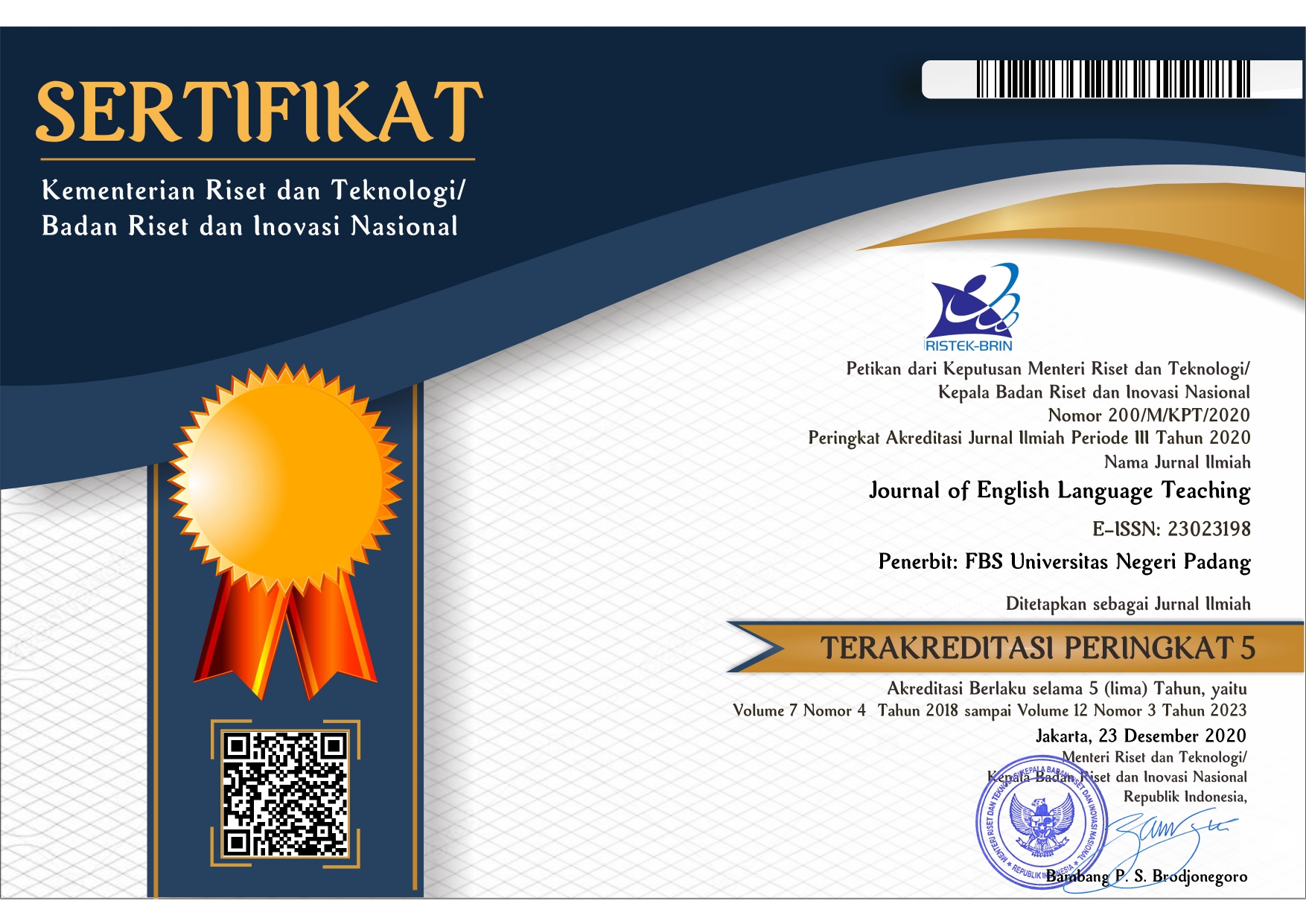
An Analysis of Teachers’ Strategies in Teaching English in Inclusive Classrooms at SMP Pembangunan Laboratorium UNP
 ), Fitrawati Fitrawati(2),
 (1) Universitas Negeri Padang
 Indonesia
(2) Universitas Negeri Padang
Indonesia
Corresponding Author
Copyright (c) 2025 Zurnisasi Zurnisasi
DOI : https://doi.org/10.24036/jelt.v14i3.135316
Full Text:
 Language : en
Abstract
This study investigates the teaching strategies used by an English teacher in an inclusive classroom and the problems encountered during their implementation at SMP Pembangunan Laboratorium UNP. Inclusive education ensures equal learning opportunities for all students regardless of abilities or backgrounds. This was a qualitative descriptive approach with a case study method. This study focused on one English teacher teaching class 8B, the most diverse class in the school. Data were collected through three classroom observations, a semi-structured interview, and supporting documentation such as field notes and photographs. The findings revealed that the teacher employed various strategies, including direct instruction, expository learning, differentiated instruction, peer tutoring, and discovery learning with mind mapping.
The choice of strategies depended on classroom conditions and student engagement levels. Despite the teacher’s adaptability, several problems emerged, such as difficulty preparing suitable materials, students’ limited comprehension of instructions, lack of inclusive education training, unexpected behaviors from students with autism, and insufficient parental support. To address these challenges, the teacher utilized self-learning, discussions with colleagues and the principal, and creative problem-solving. This study underscores the importance of teacher adaptability and institutional support in inclusive classrooms, offering insights for improving inclusive English teaching practices in junior high schools in Indonesia.Keywords
References
Al-Banna, A. (2014). Teaching strategies and their impact on students’ learning. International Journal of Education, 6(2), 45–56.
Arriani, N. (2022). Inclusive education: Building equitable learning environments. Journal of Education and Society, 10(1), 15–27.
Awati, K. (2024). Understanding data validation in qualitative research. Research Methodology Journal, 8(1), 23–31.
Bizlabco. (2025). Teaching strategies for diverse classrooms. Journal of Innovative Education, 13(2), 56–68.
Creswell, J. W. (2012). Educational research: Planning, conducting, and evaluating quantitative and qualitative research (4th ed.). Pearson.
Creswell, J. W., & Miller, D. L. (2000). Determining validity in qualitative inquiry. Theory Into Practice, 39(3), 124–130. https://doi.org/10.1207/s15430421tip3903_2
Damyanov, I. (2023). Structuring qualitative interviews: A practical approach. Qualitative Research Review, 15(2), 78–90.
David, M. (2010). Triangulation in qualitative research. Qualitative Research Methods Journal, 12(4), 211–220.
Hidayanti, R. (2023). Teacher strategies in teaching English at the eleventh grade of inclusive school SMA Al Firdaus Surakarta in the academic year 2022/2023. Journal of Language Teaching and Education, 11(3), 89–102.
Issac, M. (2010). Teaching strategies: Concepts and practices. International Journal of Educational Strategies, 5(1), 32–41.
Karunia, A., Lestari, R., & Putra, Y. (2021). Observation as a method of data collection in qualitative research. Indonesian Journal of Social Research, 9(2), 45–53.
Kuhlthau, C. C. (2010). Guided inquiry: School libraries in the 21st century. School Library Media Research, 13, 1–23.
Kurniawati, D. (2020). Exploring teachers’ inclusive education strategies in rural Indonesian primary schools. International Journal of Inclusive Education, 24(12), 1231–1246. https://doi.org/10.1080/13603116.2018.1508299
Miles, M. B., & Huberman, A. M. (1994). Qualitative data analysis: An expanded sourcebook (2nd ed.). Sage Publications.
Nikolopoulou, K. (2023). Purposive sampling in educational research. Qualitative Education Journal, 18(1), 67–75.
Padmadewi, N. N. (2017). Teaching English to a student with autism spectrum disorder in a regular classroom in North Bali Bilingual School. International Journal of Language Education, 1(1), 1–11. https://doi.org/10.26858/ijole.v1i1.2869
Puspitasari, D. (2019). An analysis of teachers’ strategies in teaching English at inclusive classrooms. Indonesian Journal of English Language Teaching, 14(2), 112–123.
Rohmatullaili, A. (2023). Teacher strategies in inclusive classrooms: A qualitative study. Educational Research Journal, 17(4), 204–216.
Rojabi, A. (2019). Conducting interviews in qualitative research. Journal of English Language Teaching Research, 4(2), 98–105.
Sugiyono. (2015). Metode penelitian kuantitatif, kualitatif, dan R&D. Alfabeta.
Tichá, R., Abery, B., & Kincade, L. (2018). Effective teaching strategies in inclusive education: A practical guide. Journal of Inclusive Education, 22(5), 543–557. https://doi.org/10.1080/13603116.2017.1412506
UNICEF. (2019). Inclusive education: Every child has the right to learn. United Nations International Children’s Emergency Fund. https://www.unicef.org/education/inclusive-education
Yin, R. K. (2018). Case study research and applications: Design and methods (6th ed.). Sage Publications.
 Article Metrics
 Abstract Views : 141 times
 PDF Downloaded : 13 times
Refbacks
- There are currently no refbacks.
Copyright (c) 2025 Zurnisasi Zurnisasi

This work is licensed under a Creative Commons Attribution-NonCommercial 4.0 International License.